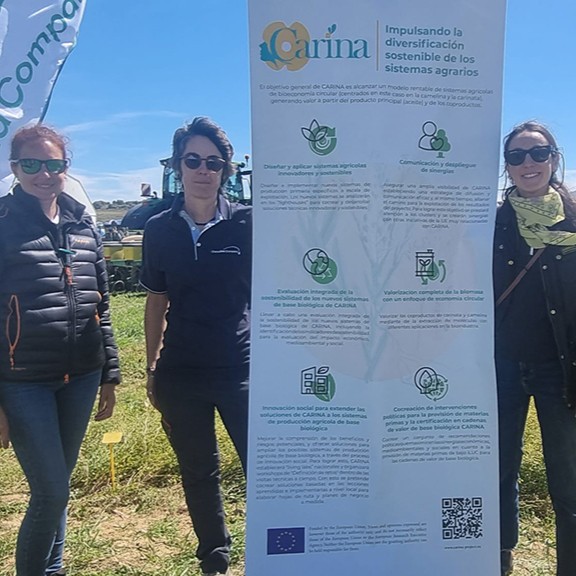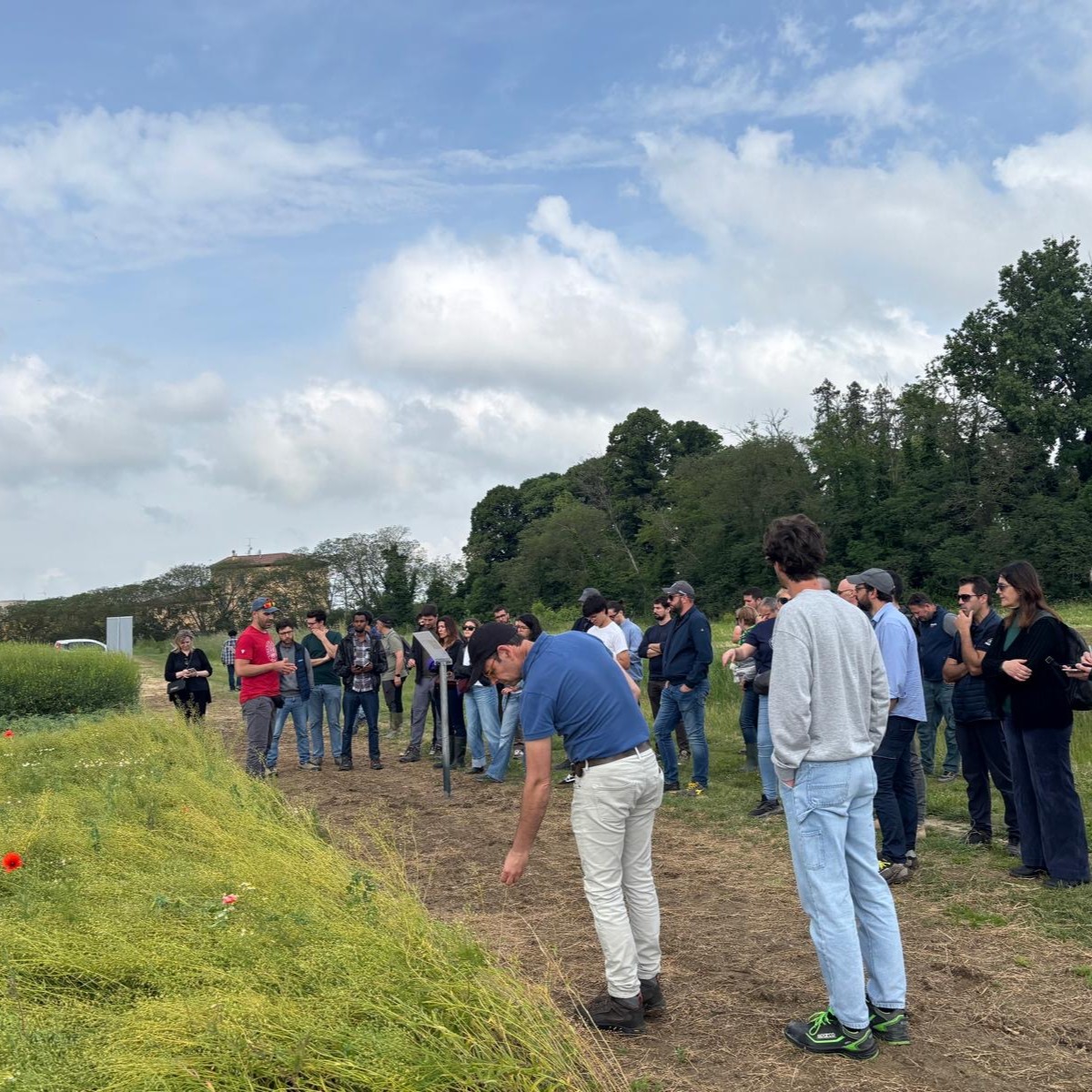

A dedicated workshop contributing to the wider programme of ECOMONDO, Europe’s leading trade fair for the green and circular economy, was organised in Rimini on 6 November 2025 by Alma Mater Studiorum – Università di Bologna in cooperation with the Roundtable on Sustainable Biomaterials and Spanish Co-ops.
The event formed part of CARINA’s activities supporting the ex-ante assessment of policy interventions relevant to the future development of bio-based value chains in Europe. The workshop combined an in-person session in Rimini with online participation and was part of a broader CARINA workshop series dedicated to policy analysis and stakeholder engagement.
To support the objectives of CARINA project, CARINA organised a series of participatory workshops designed to bring together stakeholders from different countries and professional backgrounds. The goal was to identify policy gaps and opportunities related to the adoption of camelina and carinata. Two workshops were held: one in April 2025 in Hammamet, Tunisia, and a second in November 2025 during ECOMONDO. Both workshops applied systemic and future-oriented thinking tools to explore long-term scenarios and co-create evidence-based visions, using structured community-based learning approaches to support collective reflection and decision-making.
Objectives and structure of the ECOMONDO workshop
The workshop titled “Co-creation of Policy Interventions for the Development of Bio-based Value Chains in Europe – Scenarios Exploration and Transition Pathways”, aimed to collaboratively develop and analyse plausible policy intervention scenarios for bio-based value chains in Europe. Participants explored potential policy pathways by examining first-order effects, value-chain impacts, trade-offs, co-benefits and compensatory measures, as well as the roles of different stakeholders in supporting transitions towards sustainable bio-based products.
The workshop followed a hybrid format, with participants divided into three working groups: one in-person group and two online groups. Individual reflections and collective outputs were captured and later synthesised. In the first phase, participants assessed the expected performance of selected indicators for CARINA value chains by 2035, drawing on projected trends for oil crops based on EU and FAO data. In the second phase, guided discussions focused on four alternative policy scenarios, analysed from multiple perspectives, including hotspots, key performance indicators across different time horizons, and stakeholder involvement.
Overview of the explored scenarios
Four scenarios describing alternative future pathways for camelina and carinata value chains by 2035 were examined:
Scenario 1: Financial Incentives and CAP Reform described a future where targeted CAP reforms provide regionally differentiated, performance-based payments for cultivating camelina and carinata. While adoption increases due to financial attractiveness and the emergence of specialised cooperatives, uptake is driven mainly by subsidies rather than ecological or knowledge-based motivations.
Scenario 2: R&D and Innovation envisaged extensive public investment in research leading to improved varieties, tailored machinery and crop protection tools. Innovation hubs and pilot farms support early adoption, but limited regulatory alignment and public awareness constrain expansion beyond innovation-driven regions.
Scenario 3: Regulatory and Market Access Facilitation focused on streamlined regulation, easier licensing and inclusion of camelina and carinata in RED Annex IX Part A. Reduced administrative barriers enable supply chains to develop, particularly in regions previously constrained by regulatory complexity, despite moderate market demand and R&D investment.
Scenario 4: Knowledge Sharing and Public Engagement described widespread awareness driven by NGOs, media and eco-labelling, leading to adoption motivated by reputational benefits and market narratives. Cultural acceptance plays a key role, though uptake remains limited without strong economic incentives, certification and technical support.
Key findings and synthesis
Discussions on production and market projections indicated a moderately positive outlook for camelina and carinata over the next decade, supported by gradual scaling, technological learning and favourable policy frameworks. Participants expected stable seed prices, moderate yield improvements and slight expansion of cultivated areas, production and crushing volumes. Market development was seen as strongly dependent on RED III sustainability certification. Food and feed uses were expected to remain stable, while views on future demand for bioplastics were mixed.
In contrast, rapeseed was assessed more cautiously. Prices and yields were expected to remain stable or decline slightly, with high volatility linked to policy instruments, subsidies and imports. While processing capacity and policy-driven demand could support marginal growth, rapeseed was viewed as more exposed to regulatory, market and environmental risks.
Across the scenarios, participants considered Scenarios 1 and 3 the most relevant overall, while emphasising that long-term development of camelina and carinata value chains cannot rely on single policy levers alone. Scenario 1 was viewed as realistic but structurally fragile if based primarily on subsidies. Scenario 2 highlighted the importance of innovation but underlined the need for parallel market and certification development. Scenario 3 was seen as a strong accelerator, provided regulatory clarity is accompanied by agronomic support, credible certification and fraud-resistant systems. Scenario 4 demonstrated the supporting role of awareness, but only when combined with economic viability and practical knowledge transfer.
Overall, participants agreed that camelina and carinata value chains can only develop through the consistent and combined evolution of agronomy, markets, policies and certification frameworks, rather than through isolated interventions.