


From 3–7 September 2025, CARINA partner PEDAL Consulting presented the project at Agrokomplex, Slovakia’s largest agricultural exhibition, celebrating its 50th edition. With more than 92,000 visitors and over 500 exhibitors from nine countries, the fair provided a unique opportunity to connect with farmers, researchers, companies, and the general public.
In Pavilion M2, dedicated to research and innovation, PEDAL Consulting engaged visitors in discussions about European projects and their role in shaping the future of agriculture. CARINA was presented both at the stand and through a dedicated lecture, “Intelligent crops, stronger future – Discover carinata & camelina with the CARINA project.”
The presentation highlighted the key advantages of camelina and carinata:
• Ability to grow on soils unsuitable for traditional crops
• Potential as sources of oil for biofuels and biomaterials
• Valuable co-products for animal feed
• Positive effects on crop rotation practices
Visitors showed strong interest in the potential of these crops, leading to lively exchanges about their role in strengthening Slovak agriculture.
CARINA’s participation at Agrokomplex confirmed the growing awareness and enthusiasm for innovative, sustainable farming practices, and demonstrated the importance of connecting research with real opportunities for farmers and communities.

Local Protein, Global Impact: Reducing EU Dependency on Imports
Europe imports over 70% of its protein-rich animal feed, much of it from regions facing deforestation and social conflict. The European Commission has made protein autonomy a strategic goal, and sustainable crops like carinata or camelina are part of the answer.
These oilseeds offer a local, low-emission protein source. Their seed cake, a by-product of oil extraction, contains high-quality protein suitable for livestock and aquaculture feed. Crucially, they can be grown on existing farmland, avoiding land-use change or additional environmental burden.
Promoting home-grown protein helps stabilize prices, support farmers, and improve food system sovereignty.
Dive into the policies behind this initiative:
Common Agricultural Policy (CAP) 2023–2027: https://agriculture.ec.europa.eu/cap-overview/cap-2023-2027_en
EU Protein Plan Overview: https://op.europa.eu/en/publication-detail/-/publication/1b8aa815-b122-11ec-83e1-01aa75ed71a1

Powering the Bioeconomy: Sustainable Crops for Circular Futures
The EU Bioeconomy Strategy envisions a shift from fossil-based feedstocks to renewable biological resources. Bio-based innovation is no longer a niche, it’s a central pillar of Europe’s economic and environmental strategy.
Camelina and carinata are perfectly suited to this vision. Their oils can be transformed into bioplastics, bioherbicides, and bio-lubricants. The residual protein-rich cake can serve as a sustainable animal feed or be further processed into high-value compounds.
By valorizing every part of the crop and fitting seamlessly into current supply chains, CARINA demonstrates what circular agriculture looks like in practice. This approach reduces waste, replaces fossil-derived inputs, and creates rural jobs.
Find out more:
EU Bioeconomy Strategy: https://research-and-innovation.ec.europa.eu/research-area/environment/bioeconomy_en
Circular Economy Action Plan: https://environment.ec.europa.eu/strategy/circular-economy-action-plan_en

From Soil to System: How Biodiversity and Crop Choices Shape Resilience
Soil is more than dirt, it’s the foundation of life. Yet a significant portion of Europe’s soils are unhealthy, threatening food security and climate resilience. The EU’s Soil Health Law and Biodiversity Strategy both emphasize the urgent need to restore soil functionality and ecosystem richness.
CARINA’s focus on carinata and camelina offers more than new oilseed varieties. These crops actively improve soil biodiversity and structure, particularly when used in rotation with cereals or legumes. Their adaptability and low-input requirements reduce environmental pressure, while enhancing overall agroecosystem health.
In addition, by supporting pollinators and beneficial insects, these crops align perfectly with the EU’s ambition to halt biodiversity loss and restore pollinator habitats.
Explore relevant policies:
EU Soil Health Law (Proposal): https://environment.ec.europa.eu/topics/soil-and-land/soil-health_en
Biodiversity Strategy 2030: https://environment.ec.europa.eu/strategy/biodiversity-strategy-2030_en

Why Crop Diversification Is Key to a Sustainable Europe
Europe’s agricultural system stands at a pivotal crossroads. The European Green Deal, the Farm to Fork Strategy, and the Biodiversity Strategy 2030 all point to a common objective: building a climate-resilient, biodiversity-rich, and resource-efficient food system. At the heart of this transformation lies a deceptively simple principle – diversification.
Crop diversification isn’t just about what grows in the soil. It is a keystone solution to limit soil erosion, reduce emissions, enrich ecosystems, and secure farmer livelihoods. This is where CARINA steps in. By introducing sustainable, low-resource demanding oilseed crops like carinata or camelina, the CARINA project offers a viable path for the transition towards resilient farming systems.
These crops not only thrive in marginal or degraded soils, but also complement existing rotations, improve soil structure, and require fewer chemical inputs. For farmers, that means better environmental outcomes and additionnal income, contributing to enhanced resilience of European farms.
Learn more about the policy drivers shaping this transformation:
European Green Deal: https://commission.europa.eu/strategy-and-policy/priorities-2019-2024/european-green-deal_en
Farm to Fork Strategy: https://food.ec.europa.eu/horizontal-topics/farm-fork-strategy_en
EU Biodiversity Strategy for 2030: https://environment.ec.europa.eu/strategy/biodiversity-strategy-2030_en

Co-creation of Policy Interventions for Feedstock Provision and Certification
One of the key objectives of the CARINA project is to support the development of policy interventions that promote certified low indirect Land-Use Change (iLUC) feedstock for bio-based value chains. To this end, the focus is put on identifying synergies in sectoral strategies and delivering practical policy recommendations.
The activities centre around developing analytical tools and frameworks to assess the current policy landscape, with particular attention to innovative agricultural systems, certification schemes, and methodologies for Monitoring, Reporting, and Verification (MRV). As part of this work, policy factsheets were prepared for countries with more mature camelina and carinata value chains, namely Spain, France, Italy, and Germany. These factsheets aim to help policymakers and practitioners explore, evaluate, and refine existing policy instruments.
To ensure real-world relevance and applicability, CARINA partners carried out Policy Innovation Labs (PILs). These workshops brought together stakeholders from across the value chain, including farmers, cooperatives, seed producers, and representatives of the processing industry, to jointly identify policy gaps and opportunities.
Looking ahead, the project will conduct foresight workshops to assess the potential impact of policy interventions through macro-level modelling. These sessions will provide valuable insights into supply chain optimisation and help minimise land use conflicts. The trade-offs identified through this work will support the creation of policy environments that mitigate negative externalities and promote sustainable agricultural development.
By integrating findings with CARINA’s broader social innovation framework, the project offers actionable tools and insights that can inform the design of effective and sustainable policies for the bioeconomy.

Winter Camelina – Field Workshop in Kozie Laski, Poland
On July 1st 2025, a CARINA field workshop was held in Kozie Laski, organised by PULS. The event focused on the presentation of winter camelina, spring camelina, and carinata in field conditions, with particular attention to plant health and development.
During the workshop, visitors had the opportunity to see both marginal and intercropping fields. The scientific staff of the CARINA project presented key aspects of agrotechnical treatments in the cultivation of camelina and carinata, followed by discussions on current and future cultivation practices, the possibilities of growing these crops on marginal land, and their potential use in intercropping systems.
The benefits of cultivating camelina and carinata, as targeted by the project, and the intended uses of the harvested crops were presented to participants. The owner of the fields also shared harvest results from previous years, providing valuable insights into the performance of these crops under local conditions.
The workshop offered a practical platform for knowledge exchange between researchers, farmers, and other stakeholders, supporting CARINA’s mission to promote sustainable and diversified cropping systems.

CARINA Presented at REDPAC Conference on Crop Rotation Best Practices in Castilla-La Mancha
On 28 May, Cooperativas Agro-alimentarias Castilla-La Mancha (CACLM) presented the CARINA Project at the REDPAC conference on best practices in crop rotation with soil-improving species for dryland areas, applicable to eco-regimes in Castilla-La Mancha.
The event took place at the Albadalejito Agroforestry Research Centre (CIAF) in Cuenca and was organised by REDPAC, part of the Ministry of Agriculture, Fisheries and Food. It brought together local farmers, farmers’ associations, industry technicians, and companies to discuss the environmental benefits of using soil-improving crops and the technical aspects of their implementation.
Cooperativas Agro-alimentarias Castilla-La Mancha took the opportunity to present the CARINA Project, highlighting how camelina and carinata are ideally suited to rainfed crop rotation in the region. Participants visited the camelina trial fields at the Albadalejito Research Centre, part of the Regional Institute for Agri-Food and Forestry Research and Development of Castilla-La Mancha. Technicians responsible for the trials emphasised the importance of applying the recommended fertiliser to camelina crops to achieve optimal results.
The day concluded with a round table discussion where several farmers shared their experiences with crop rotation management on their farms. They discussed both the benefits and challenges of implementing crop rotation, addressing aspects such as training, local adaptation, administrative simplification, and the need for research and experimentation adapted to each area.
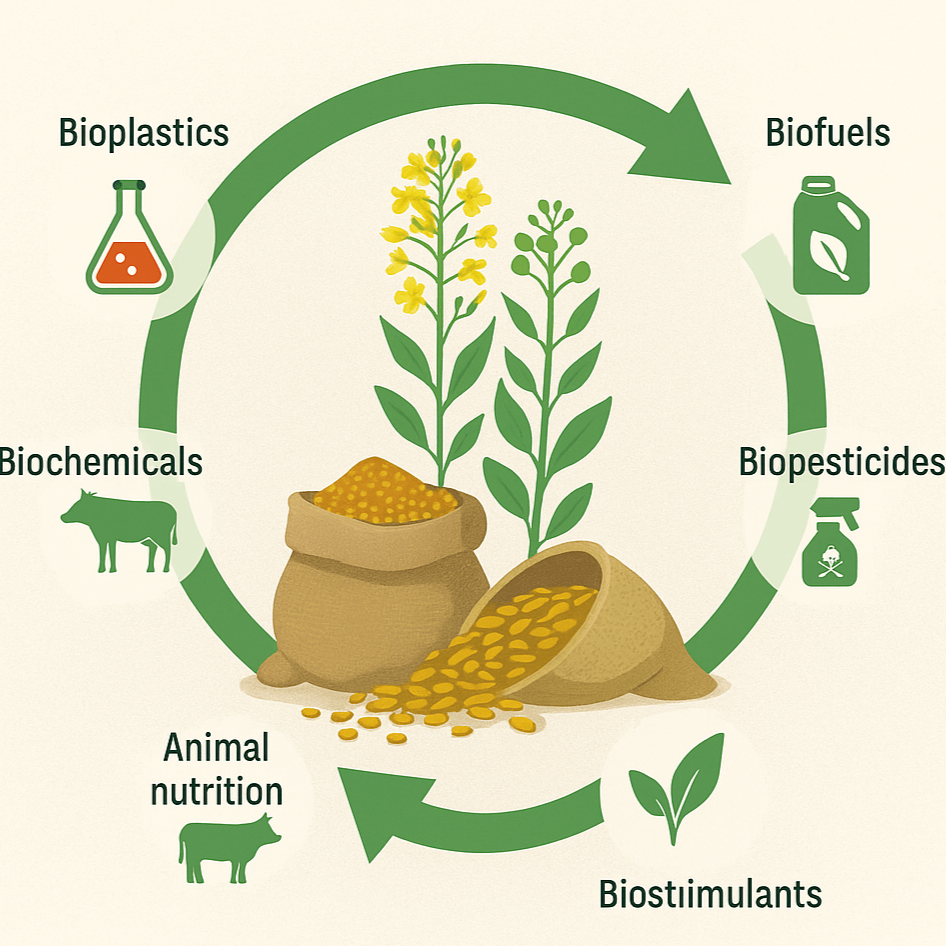
Full Biomass Valorisation with a Circular Economy Approach
As part of its mission to advance sustainable agriculture, the CARINA project is focused on the full valorisation of camelina and carinata biomass using a circular economy approach. The project aims to extract valuable molecules from co-products of these crops for diverse applications, including bioplastics, biochemicals, animal nutrition, biofuels, biostimulants, and biopesticides.
During the first period of the project, the physical and chemical characteristics of Brassica carinata and Camelina sativa seeds were analysed. Results indicated that carinata seeds contain higher levels of erucic acid than camelina. As a result, carinata oil has been used to produce dicarboxylic acids. Laboratory-scale tests confirmed the feasibility of using these acids to develop biochemicals with potential applications in bioplastics and biopesticides.
The project also investigates the optimal incorporation rate of camelina and carinata cake into animal feed, with inclusion levels ranging from 2% to 20%. Trials are currently underway, including zootechnical, palatability, and digestibility tests. Another key objective is to reduce glucosinolate (GLS) levels, an antinutritional factor, through heat treatment.
Further efforts are directed toward valorising GLS extracts from carinata seeds for potential use in biocides or phytosanitary products. Although challenges have been encountered in scaling up GLS extraction, these are expected to be resolved soon.
In addition, project partners have assessed camelina cake polysaccharide as a stabilising agent for nutraceutical formulations. This polysaccharide extract, produced at laboratory scale, is being explored for its ability to enhance the bioaccessibility of bioactive compounds.
Finally, a range of technological processes, such as enzymatic hydrolysis, ethanol extraction, fermentation, and pyrolysis, are being applied to different co-products with the goal of developing biostimulants and biopesticides.
Through these integrated research activities, CARINA continues to explore and demonstrate the potential of camelina and carinata in delivering innovative and sustainable bio-based products.
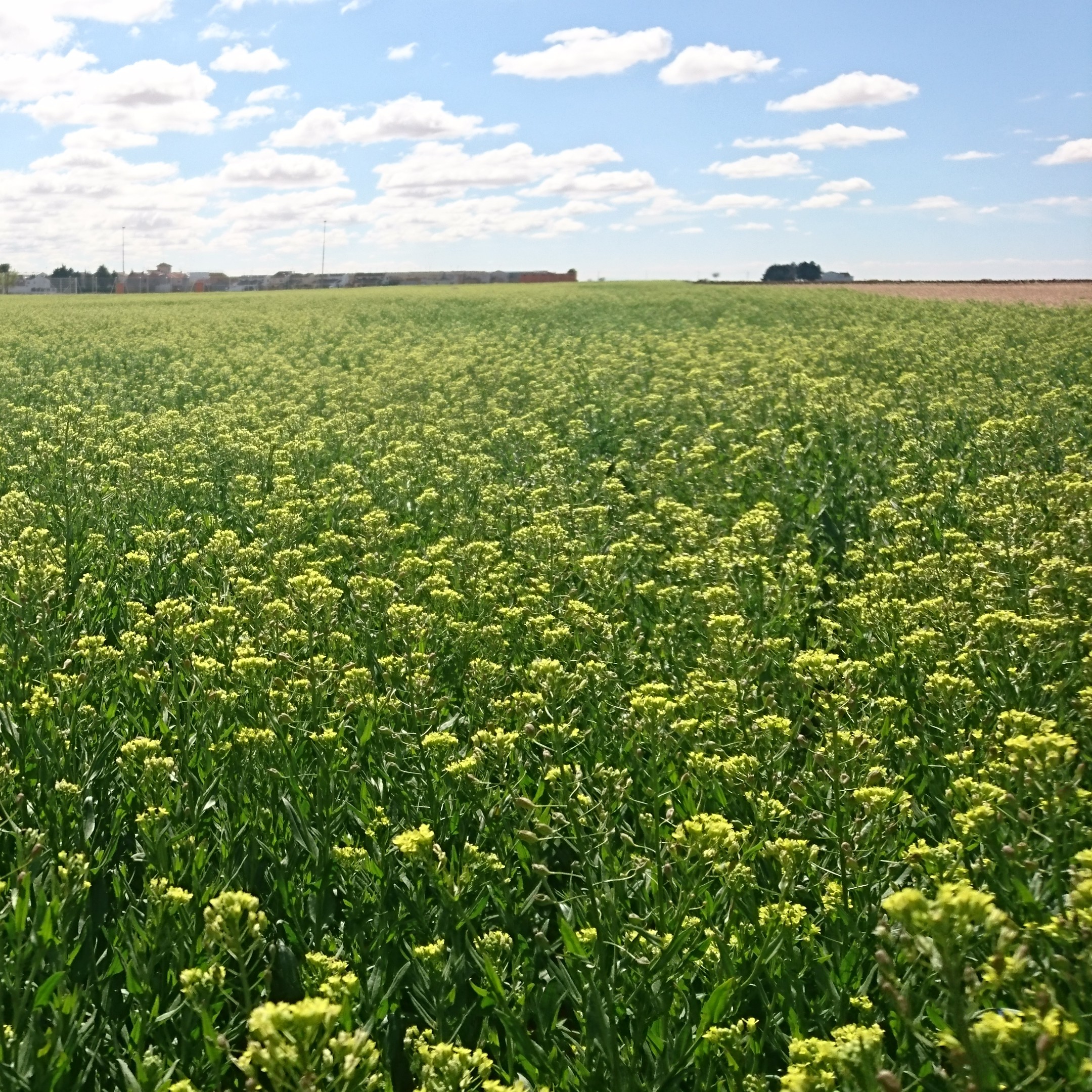
Discovering Camelina & Carinata at UNIBO’s Experimental Field! (video)
In this video, the team from UNIBO introduces camelina and carinata, their agronomic strengths and weaknesses and the strategies being tested for successful integration into sustainable cropping systems. Watch the video to see how camelina and carinata are growing in action!